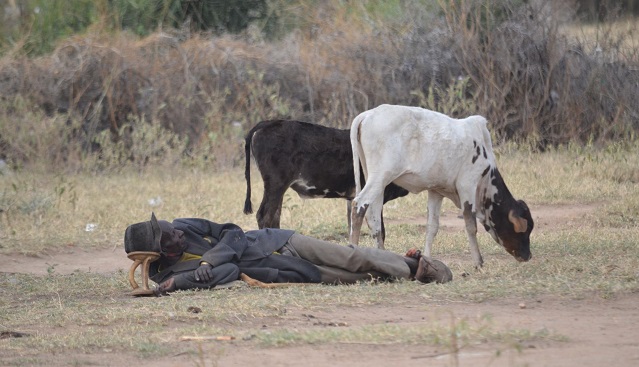
Pastoralists in Uganda’s Karamoja region are facing an existential crisis as a severe drought deepens. Climate change is rapidly dismantling their traditional way of life, which depends on predictable rain and pasture. Water sources are vanishing under relentless heat, threatening vast herds of livestock. Consequently, communities are now grappling with extreme water scarcity, unfamiliar animal diseases, and escalating conflicts. In Moroto District alone, approximately 300,000 cattle require an estimated 15 litres of water each per day. This demand is impossible to meet as dams like Kobebe, now crowded with over 50,000 cattle, are drying up due to siltation and evaporation. Therefore, the situation for Karamoja pastoralists is becoming untenable, forcing drastic survival measures.
The crisis is compounded by converging pressures. Herders from Kenya’s Turkana region and other Ugandan districts have congregated at the few remaining water points. This concentration places immense strain on limited resources. Furthermore, climate change has introduced new livestock diseases, with pastoralists reporting mysterious, fatal tick-borne illnesses. Michael Achia, a herdsman from Napak District, explains that water scarcity forces them to compete with local communities for borehole water. He has lost five cows in three months to disease. Many animals are now trekking over 100 kilometres for water and pasture. This unsustainable reality is pushing Karamoja pastoralists toward poverty, food insecurity, and increased migration, raising the risk of conflict with neighboring regions.
The Collapse of Traditional Water Infrastructure
The region’s traditional water infrastructure has failed under climate stress. Shallow dams and cattle watering traps, once reliable, are drying up quickly due to excessive heat and siltation. Emmanuel Areman, a pastoralist, notes that most dams are now useless during prolonged dry seasons. This forces humans and livestock to share the same contaminated sources, posing health risks and causing frequent borehole breakdowns. Communities like those in Lotome Sub-county report all water points have dried up. Women walk over 25 kilometres to fetch water, while men migrate with livestock for months. The government’s existing water systems are inadequate for current climatic pressures. Pastoralists are urgently appealing for the construction of large, resilient dams capable of retaining water throughout intensifying dry periods.
New Diseases and Environmental Threats
Changing environmental conditions are spawning new threats to livestock health. Dr. Moses Okino, Moroto District Veterinary Officer, confirms that climate change has altered disease patterns. New tick-borne diseases, first detected in Kenyan cattle, have now spread into Karamoja. Additionally, newly identified poisonous plant species in Rupa Sub-county are harming animals. Poor pasture nutrition, a direct result of drought, weakens livestock immunity. This makes them more susceptible to illness and reduces milk and meat productivity. As a result, pastoralists are forced to sell animals at low prices to avoid total loss. The combination of disease, poor nutrition, and water scarcity creates a devastating cycle that erodes the primary asset and food source for Karamoja pastoralists, undermining their entire economy and nutritional security.
Social Strain and Conflict Over Resources
The scarcity of water and pasture is intensifying social tensions. Competition is fierce between pastoralists, local communities, and conservation authorities. Frank Lopeyok of KAYESE notes that gazetted wildlife land has reduced available grazing areas, creating flashpoints. Long treks in search of resources frequently lead to conflicts with farmers in neighboring regions like Teso. Migration, once a traditional adaptation strategy, is now restricted and dangerous. Families are separated for long periods, raising safety concerns for women and children left behind. Elder Jackson Angella calls for dialogue with neighboring regions to formalize resource-sharing agreements. Without such cooperation, the desperate search for survival will likely lead to more frequent and violent clashes, destabilizing the entire sub-region.
Failed Coping Mechanisms and Environmental Degradation
In the face of extreme stress, some coping mechanisms are worsening the problem. Pastoralists are burning bushes to stimulate fresh grass growth and kill ticks, a practice that can lead to broader ecological damage. Meanwhile, environmental officer Zackary Angella Lochoro warns that climate stress is driving communities to destructive income-generating activities like charcoal burning. This accelerates deforestation and soil degradation, creating a feedback loop that intensifies drought and heat. Traditional knowledge is proving inadequate against unprecedented climatic shifts. Many community members still attribute the changes to spiritual causes, highlighting a critical gap in climate change awareness and education. Effective adaptation requires not just physical infrastructure but a fundamental shift in understanding and practice.
Pathways for Adaptation and External Intervention
Addressing the crisis requires immediate and coordinated intervention. Construction and rehabilitation of large-scale water harvesting infrastructure is the most urgent need. Non-profits like KAYESE have launched tree-planting campaigns to mitigate climate effects, but these are long-term solutions. In the short term, veterinary services must be scaled up to combat new diseases. Climate awareness campaigns are essential to help communities understand the scientific basis of changes and adopt sustainable practices. Critically, regional dialogue must be fostered to manage migration and resource sharing peacefully. The plight of Karamoja pastoralists is a stark warning. Their struggle to adapt underscores the severe, on-the-ground impacts of climate change on vulnerable populations whose livelihoods are inextricably tied to a stable environment. Without significant support, their way of life may not survive the coming decades.