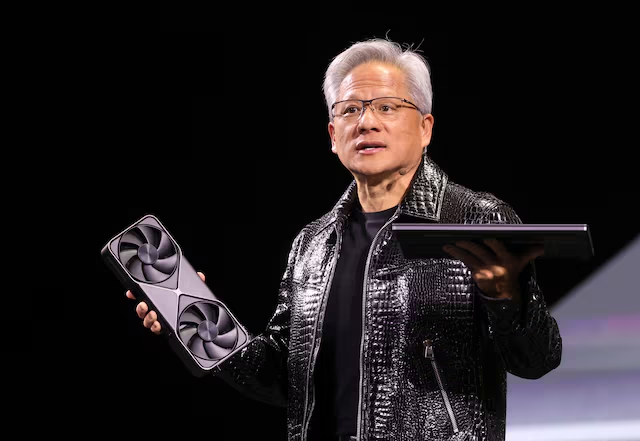
Nvidia CEO Jensen Huang announced on Monday that the company’s next-generation Nvidia Vera Rubin chips are now in “full production.” He made the statement at the Consumer Electronics Show (CES) in Las Vegas.
He said the new chips deliver five times the AI computing power of previous models. This boost applies especially when running chatbots and other generative AI apps.
The Nvidia Vera Rubin chips will launch later this year. AI firms are already testing them in Nvidia’s labs. This move comes as competition heats up.
Nvidia now faces pressure not only from AMD but also from major customers like Google. These companies are increasingly designing their own AI chips.
Huang unveiled the Vera Rubin platform. It combines six separate Nvidia chips into one system. The flagship server includes 72 graphics units and 36 new central processors.
He showed how these can link into “pods” with over 1,000 Rubin chips. Such systems can make AI token generation ten times more efficient. Tokens are the basic building blocks of language models.
However, this performance leap requires a new data format. Nvidia developed it internally and hopes the industry will adopt it.
“This is how we achieved such a big performance jump,” Huang explained. “We only increased transistor count by 1.6 times.”
Nvidia still leads in AI training. But competition is fiercer in inference—the stage where AI serves responses to users.
Much of Huang’s talk focused on optimizing the Nvidia Vera Rubin chips for real-time AI tasks. He highlighted a new feature called “context memory storage.”
This technology helps chatbots handle long conversations faster and more coherently.
Nvidia also launched next-gen networking switches with “co-packaged optics.” This tech links thousands of machines into unified AI systems. It competes directly with offerings from Broadcom and Cisco.
Early adopters include cloud provider CoreWeave. Nvidia also expects Microsoft, Oracle, Amazon, and Alphabet to deploy the new systems.
In another update, Huang introduced Alpamayo—a new software suite for self-driving cars. It helps vehicles choose safe paths and logs decisions for engineers to review later.
Notably, Nvidia will open-source both the model and its training data. “Only then can you truly trust how the models came to be,” Huang said.
Last month, Nvidia acquired talent and chip tech from startup Groq. Some Groq engineers previously helped Google design its AI chips.
Although Google remains a key Nvidia customer, its custom chips now pose a growing threat. During a Q&A, Huang said the Groq deal “won’t affect our core business.” But it may lead to new products.
Meanwhile, demand for older H200 chips remains strong in China. Former President Donald Trump allowed their export, sparking concern among U.S. policymakers.
CFO Colette Kress confirmed Nvidia has applied for licenses to ship H200s to China. The company is still waiting for approvals from the U.S. and allied governments.
As the AI race accelerates, the Nvidia Vera Rubin chips aim to extend Nvidia’s lead. They combine raw power with smarter design, open collaboration, and strong partnerships.
For now, Nvidia remains central to the AI revolution. But rivals are closing in fast.