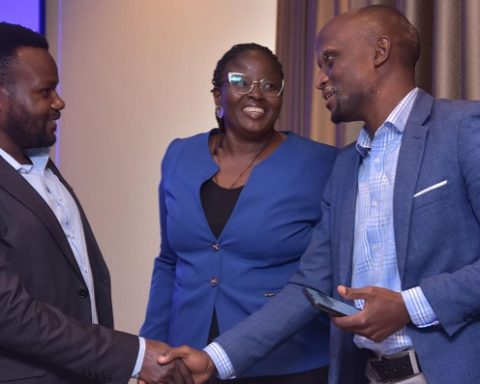
Kizza Besigye’s non-violent plan outlines a bold and peaceful path for Ugandans to regain power through civil resistance. Speaking from Luzira Prison in a pre-recorded message, the four-time presidential aspirant unveiled his strategy during the launch of the People’s Front for Freedom (PFF) at the party headquarters in Kampala.
First, Dr Besigye emphasized that political change does not require armed struggle. Instead, he highlighted the strength of non-violent resistance, which causes fewer casualties while remaining just as effective. For example, he referenced the Bush War that brought President Museveni to power. Although it removed a dictator, it ultimately failed to solve the deeper problem of entrenched authoritarianism.
Therefore, “Our mission must go beyond removing a dictator,” Dr Besigye stated. “We need to build a system where citizens control decisions, institutions, resources, and information.” His vision prioritizes a sustainable democratic structure rather than short-term political shifts.
Importantly, Kizza Besigye’s non-violent plan does not imply submission or silence. “Though our strategy avoids violence, it won’t be peaceful. We will resist injustice actively,” he said. He also warned that dictators often use propaganda to portray themselves as protectors while casting reformers as troublemakers. This manipulation keeps people trapped in fear and ignorance.
Moreover, Dr Besigye offered practical guidance. He encouraged villagers to demand services through organized, peaceful pressure. “If your village lacks schools or water, organize and demand action. You don’t need violence to hold leaders accountable,” he said. Additionally, in cases of land grabbing, he advised communities to unite in resistance and protect their land legally and visibly.
The PFF’s launch symbolized a significant shift in Uganda’s political landscape. After breaking away from the Forum for Democratic Change (FDC), the new party received official recognition from the Electoral Commission and began organizing under a federalist vision for Uganda.
Subsequently, the party introduced a 15-member Council of Eminent Persons. Dr Besigye leads the council, with Mr Wasswa Birigwa serving as deputy. Notable figures like Wafula Oguttu, Chapaa Karuhanga, James Garuga, Wycliffe Bakandonda, William Mukaira, and human rights lawyer Laudislus Rwakafuzi complete the leadership team.
Furthermore, Mr Oguttu explained PFF’s vision for a federal Uganda. “We aim for 15 federal states. Once we take office, each region will manage its own affairs and finances. Kampala won’t hoard resources,” he said. This model promises to decentralize power and ensure fairer distribution of national wealth.
In addition, the party announced its National Executive. Kampala Lord Mayor Erias Lukwago chairs the team, with Nicholas Kamara, Albert Okello, Betty Aol Ocan, and Dr Lulume Bayiga as deputies. Ms Salaam Musumba serves as speaker of the national convention, supported by Kenneth Opoka. Ibrahim Ssemujju holds the role of secretary-general, heading national mobilization and communication.
Likewise, Lukwago reaffirmed that shared values unite the PFF team. He cited unity, democracy, transparency, justice, and constitutionalism as core principles of their movement.
Meanwhile, Ms Musumba recalled how a team of 12 reformists led by Mr Wafula worked to rebuild Uganda’s opposition after internal conflicts rocked the FDC. Their dedication laid the groundwork for PFF.
Several opposition veterans attended the event, including former presidential candidate Mugisha Muntu and Conservative Party’s Ken Lukyamuzi. Notably, Muntu praised PFF’s formation, stating that it disproves President Museveni’s claim that Uganda would lack an opposition by 2026.
Through Kizza Besigye’s non-violent plan, PFF aspires to build a grassroots movement that educates, mobilizes, and empowers Ugandans. Ultimately, the goal is not just regime change but real transformation—one that prioritizes inclusive governance and equal opportunity for all.
In conclusion, the plan offers hope. By uniting communities and rejecting violence, Ugandans can reclaim their nation and reshape its future.
Read: Kizza Besigye Court Walkout Sparks Legal Controversy in Uganda