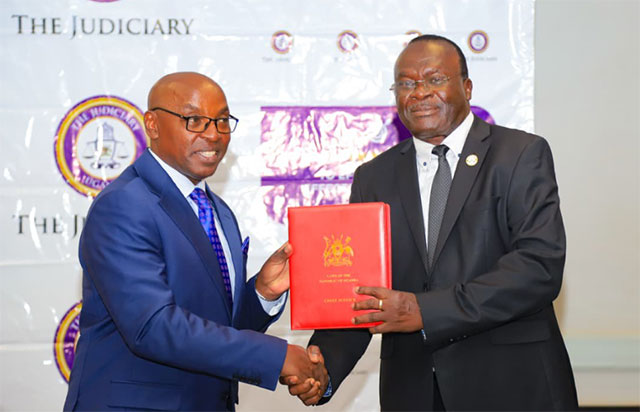
President Yoweri Museveni has appointed Dr. Flavian Zeija as Uganda’s new Chief Justice. The appointment follows the retirement of former Chief Justice Alfonse Owiny-Dollo. Justice Owiny-Dollo retired upon reaching the mandatory judicial age of seventy. Consequently, Zeija, who served as Deputy Chief Justice, has been elevated to the top judicial office. Parliament completed its vetting and approval process prior to the presidential appointment. The Judicial Service Commission recommended Zeija among three shortlisted candidates. This transition marks a significant shift in the leadership of Uganda’s judiciary.
The handover ceremony occurred swiftly this afternoon. Outgoing Chief Justice Owiny-Dollo formally transferred authority to Zeija. This action complied with legal requirements for an outgoing head of judiciary. Zeija had been serving as acting Chief Justice since Monday. His rapid ascent is notable; he served as Deputy Chief Justice for less than a year. Previously, he held the position of Principal Judge. His appointment surprised some observers within the judicial system. Many learned of the news via the Parliament website before official internal communication.
The Appointment Process and Constitutional Procedure
The appointment follows a clear constitutional pathway. Article 142(1) of Uganda’s 1995 Constitution grants the President appointing power. However, the President must act on the advice of the Judicial Service Commission. The Commission conducted the recruitment process. It reportedly shortlisted three candidates: Justice Zeija, Justice Izama Madrama, and Justice Mike Chibita. The Commission then forwarded these names to the President for final selection. Subsequently, the chosen nominee underwent parliamentary approval.
Parliament’s role is to vet the nominee for suitability. This process was completed prior to the State House announcement. The President’s formal appointment came only after parliamentary consent. This procedure aims to ensure judicial independence and accountability. Nonetheless, the swift timeline prompted some internal surprise. Permanent Secretary to the Judiciary, Dr. Rose Nassali, initially stated she was unaware of the appointment. She cited her absence due to a former minister’s burial arrangements. This indicates a potential communication gap within the judiciary’s administration.
Profile of the New Chief Justice
Dr. Flavian Zeija brings considerable judicial experience to his new role. He served as Principal Judge before becoming Deputy Chief Justice. The Principal Judge oversees the High Court’s administration and operations. Therefore, Zeija possesses deep managerial insight into the court system. His appointment as Deputy Chief Justice occurred on February 7, 2025. He replaced Deputy Chief Justice Emeritus Richard Buteera. His tenure in that deputy role was brief but evidently impactful.
His academic credentials include a doctorate, signifying a strong scholarly background. His career progression demonstrates steady ascent through the judicial ranks. Observers will now monitor his approach to leading the judiciary. Key challenges include case backlogs, resource constraints, and maintaining judicial independence. His prior administrative experience as Principal Judge will be crucial. Furthermore, his relationship with the executive branch will be scrutinized. The Chief Justice must balance constitutional duties with the practicalities of governance.
Immediate Transition and Handover Dynamics
The transition between Chief Justices involved two handover ceremonies. The first occurred on Monday afternoon privately. It was reportedly conducted hurriedly to avoid public criticism about delay. A second, more formal handover happened today with media presence. This dual process highlights the sensitivity of leadership changes at this level. The law mandates the outgoing Chief Justice to hand over to the deputy if no substantive appointment is made. Since Zeija was the deputy, he immediately assumed acting responsibilities.
This seamless transition ensures continuity in judicial leadership. There is no vacuum in authority, which is vital for institutional stability. The outgoing Chief Justice expressed confidence in the handover process. He emphasized adherence to legal protocols during the ceremony. The judiciary now moves forward under new leadership. However, the surprise element of the appointment suggests internal processes may lack transparency. This could be an area for review under the new Chief Justice’s tenure.
Challenges and Expectations for the New Leadership
Chief Justice Flavian Zeija assumes office during a complex period. The Ugandan judiciary faces persistent case backlogs that delay justice. Budgetary limitations often hinder court operations and technological upgrades. Additionally, maintaining the perception of judicial independence remains a constant challenge. The new Chief Justice must navigate these issues while upholding the rule of law. His administrative experience will be immediately tested.
Another expectation involves modernizing court processes. Digitalization and efficiency reforms are urgent public demands. Furthermore, the judiciary’s relationship with other government arms requires careful management. The Chief Justice must be a staunch defender of judicial authority. His leadership style and early decisions will set the tone. The legal community and the public will watch for signals of reform and integrity. His appointment, while swift, offers an opportunity for renewed momentum in addressing systemic issues.
Broader Implications for Uganda’s Judicial System
This appointment represents more than a personnel change. It signals a new chapter for Uganda’s third arm of government. The Chief Justice influences judicial policy, appointments, and constitutional interpretation. Therefore, Zeija’s philosophy will shape the courts’ direction for years. His approach to precedent, judicial activism, and administrative reform will become clear.
The surprise surrounding his appointment may fade as substantive work begins. The focus will shift to his capacity to deliver justice effectively. International observers also monitor judicial independence in Uganda. The new Chief Justice’s actions will either bolster or undermine confidence in the system. Ultimately, his legacy will be defined by his commitment to fairness, efficiency, and the unwavering application of the law.