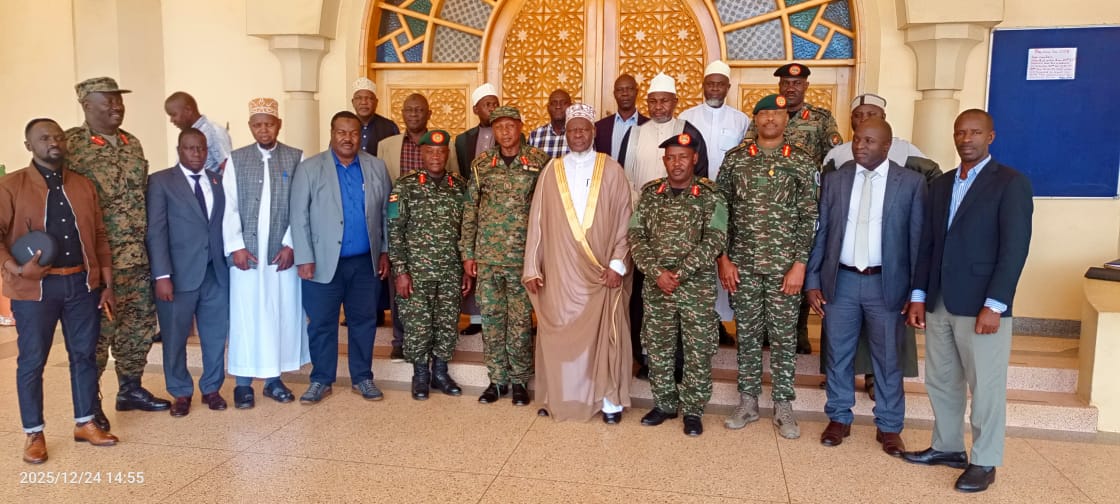
The UPDF engagement with Muslim leaders Uganda reflects a strategic effort to foster peace ahead of the 2026 national elections. Recently, a senior Uganda People’s Defence Forces (UPDF) delegation, led by Maj. Gen. Henry Masiko, visited Sheikh Shaban Ramadhan Mubaje, the Mufti of Uganda, at the Uganda Muslim Supreme Council (UMSC) headquarters in Old Kampala.
According to Maj. Gen. Masiko, who serves as UPDF Chief Political Commissar, the visit follows standing army orders. Specifically, these orders direct the military to consult key stakeholders—including religious leaders—as part of its civic and political outreach. He explained, “This is part of our duty. We have been visiting mainstream religious leaders to deliver a message of peace and stability as the country prepares for elections early next year.”
Moreover, he stressed that religious leaders deeply influence their communities. Therefore, he urged them to promote calm before, during, and after the electoral period. He added, “Your messages reach the people. We would appreciate it if you encourage harmony and advise your followers to stay calm during this critical time.”
In addition, Masiko outlined four key areas where the UPDF engages civilians. He emphasized that professional, disciplined soldiers make up the army, and they remain committed to protecting Ugandans. “Ultimately,” he affirmed, “the UPDF will never turn against the people it serves.”
Also present at the meeting were Maj. Gen. Samuel Kawagga and Brig. Gen. Abdurahman Rugumayo. Both officers highlighted unity and social harmony as essential for national stability and development. They stressed that peaceful elections require collective responsibility from all sectors of society.
In response, Mufti Mubaje warmly welcomed the delegation. He began by sharing a brief history of the UMSC and noted that he has served as Mufti for 25 years. Furthermore, he described the council’s ongoing constitutional reforms. He explained that these reforms have restored order within the Muslim community. “They have truly helped bring sanity back,” he said, adding that President Yoweri Museveni supports the process.
Beyond internal reforms, the Mufti went on to explain how major religious institutions created the Inter-Religious Council of Uganda. This initiative, he said, promotes peaceful coexistence and mutual respect among different faiths nationwide. As a result, interfaith dialogue has strengthened social cohesion across regions.
Finally, he assured the UPDF delegation that the UMSC fully supports peacebuilding. “We remain committed,” he declared, “to ensuring that Muslim clerics preach peace, tolerance, and mutual understanding among the faithful.”
Overall, this meeting marks another step in the UPDF’s broader strategy to partner with faith-based leaders. By strengthening ties with institutions like the UMSC, the military hopes to prevent election-related tensions and uphold national unity. As Uganda moves closer to 2026, such collaborations could play a vital role in ensuring a peaceful and orderly electoral process. Indeed, when religious and state institutions work together, they create a stronger foundation for democracy and stability.